
Ethics Washing and Responsible AI Branding in Canada
Amitav Johri
Sep 23, 2025

Introduction
The rapid development of artificial intelligence (AI) technologies has prompted growing calls for ethical oversight. Specifically, AI systems are increasingly embedded into decision-making processes such as credit approvals in finance, diagnostic support in healthcare, admissions assessments in education, and content moderation on social media platforms. In Canada, growing public concern about bias, accountability, and the social impact of artificial intelligence has led both the federal government and major technology firms to adopt what they describe as the principles of “Responsible AI.” By this, I employ carefully framed terms such as fairness, transparency, and accountability in official policies and corporate statements, intended to reassure the public that AI is being deployed ethically. However, in practice, Responsible AI often functions less as a governance mechanism and more as a branding device. This phenomenon, commonly referred to as ethics washing, enables companies to portray themselves as trustworthy and forward-thinking while retaining full control over the design, deployment, and evaluation of AI systems.
Defining Good AI
In this article, I define “Good AI” as artificial intelligence that is both enforceable, meaning subject to independent ethics-based auditing and legal accountability, and transparent, meaning its decision-making operations are accessible to affected stakeholders. This aligns with Mökander and Floridi’s argument that ethics-based auditing is essential for trustworthy AI governance (Mökander & Floridi, 2021). AI systems should be subject to independent audits, held legally accountable for harm, and governed by institutions that prioritize the public interest. This approach aligns with recommendations that accountability demands third-party audits and legal oversight aligned with societal values (Costanza-Chock et al., 2023). Using this definition as a benchmark, this essay evaluates whether the claims made under the banner of Responsible AI in Canada live up to their stated principles, or whether they obscure the need for structural accountability, meaning legally enforceable oversight mechanisms such as independent audits, regulatory enforcement, and public transparency.
The Algorithmic Impact Assessment in Canada
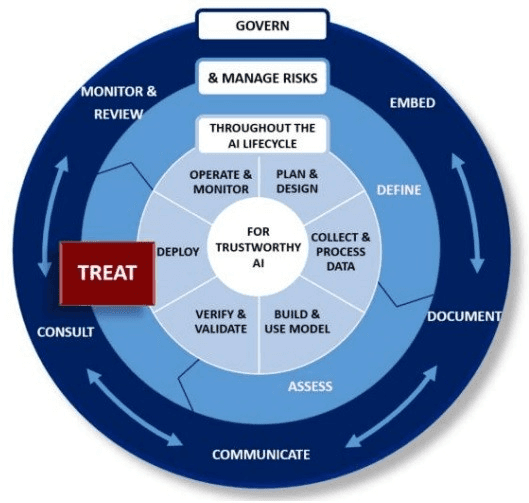
The Government of Canada has laid out its expectations through the Directive on Automated Decision-Making, notably the Algorithmic Impact Assessment (AIA). The AIA questionnaire is administered by the Treasury Board of Canada Secretariat and follows the structure outlined in the Directive on Automated Decision-Making. It includes roughly 65 risk assessment questions and 41 mitigation questions grouped across themes such as project scope, design and rationale, data and privacy, algorithmic fairness, and human oversight (Government of Canada, 2025; see Table 1.1 risk areas). Questions range from asking who is responsible for the system’s design to how algorithmic decisions are explained and reviewed, and in higher‑impact systems, whether peer review has occurred or human decision-makers remain in the loop. While robust in theory, the AIA is not legally binding and applies only to public institutions. It relies entirely on self-assessment and contains no mechanism for enforcement or third-party verification. As such, it aligns poorly with the standards of enforceability and transparency that define “Good AI.” The private sector is not bound by this framework, which is significant because most AI systems that Canadians interact with, such as social media algorithms, financial risk models, and online recommendation engines, are developed and deployed by private companies. This gap between public policy and corporate practice means that the largest and most influential uses of AI remain outside the scope of federal oversight.
Algorithmic Impact Assessment Structure
Corporate Responsible AI Branding
Separate from the Canadian government, companies such as Google and Microsoft have developed their frameworks for responsible AI usage. These documents, specifically Google’s AI Principles and Microsoft’s Responsible AI Standard, define core values including fairness, reliability and safety, privacy and security, transparency, accountability, and inclusiveness. Microsoft requires that systems undergo impact assessments, fairness testing, and the publication of “Transparency Notes” describing a model’s capabilities and limitations (Microsoft, 2022). Google commits to avoiding unfair bias through the use of diverse training data, protecting privacy by anonymizing user information, and ensuring that systems are explainable so that users understand when and how AI is being applied (Google, 2018). Both frameworks present these commitments as central to their approach to AI, but because enforcement remains internal, their effectiveness depends largely on corporate discretion rather than independent oversight. For example, Google’s AI Principles state that the company will avoid technologies likely to cause harm and commit to designing AI that is socially beneficial, which they define as prioritizing applications that improve quality of life in areas such as healthcare, accessibility, and energy efficiency, while preventing uses that may reinforce unfair bias or lead to social harms (Google, 2018). Microsoft’s Responsible AI Standard describes internal processes for developers to evaluate risk and incorporate ethical review, including the use of Impact Assessments to identify potential harms, fairness testing to detect demographic disparities, Transparency Notes to communicate model capabilities and limitations, and oversight from Responsible AI Leads and Ethics and Society teams to ensure accountability across the development lifecycle (Microsoft, 2022).

Google’s AI Principles
The Limits of Self-Regulation
Although their policies may differ, both frameworks remain internally governed, with no requirement for independent audits, regulatory registration, or public disclosure. Companies define their interpretations of harm or fairness and determine compliance unilaterally. Although documents such as Google’s AI Principles and Microsoft’s Responsible AI Standard are primarily intended for internal guidance, both companies publish them publicly to signal their commitment to ethical practices. This publicity helps shape their reputations as trustworthy leaders in artificial intelligence and reassures users, regulators, and business partners that their technologies are developed responsibly. At the same time, these voluntary standards allow firms to retain full control over the deployment of their AI systems, including recommendation algorithms, content moderation tools, and decision-support models used in finance, healthcare, and other sectors. In the absence of legal or institutional oversight, these frameworks fail the test of enforceability and provide only selective transparency.
The Case of Timnit Gebru and Stochastic Parrots
A high-profile example of the limitations of corporate ethics infrastructure can be found in the case of Dr. Timnit Gebru, a co-lead of Google’s Ethical AI team. In 2020, Gebru was forced to resign after authoring a paper that critiqued the environmental costs, embedded biases, and opacity of large-scale language models. Titled “On the Dangers of Stochastic Parrots,” the paper argued that these models replicate societal inequalities because they are trained on vast datasets that often encode biased and discriminatory language patterns, and because their sheer size and complexity make meaningful oversight and public accountability difficult (Gebru et al., 2021). Although the paper had received internal approval, Google revoked its support after the findings were deemed reputationally sensitive. Her case demonstrates that even within firms that publicly champion Responsible AI, ethical critique may be suppressed if it threatens business goals. This reveals the dangers of relying on internal governance structures in the absence of enforceable external standards.
Canada’s Legislative Approach
Canada’s policy environment has attempted to address such governance failures through legislation. Bill C‑27, the Digital Charter Implementation Act, introduces the Artificial Intelligence and Data Act (AIDA), which would require companies to assess the risks of high-impact systems, maintain documentation, and report incidents to regulators employed by the federal government, specifically under the authority of the Minister of Innovation, Science and Industry (Government of Canada, 2023). However, AIDA emphasizes self-reporting and lacks requirements for independent audit, algorithmic transparency, or disclosure of how harm is evaluated. The act leaves key terms such as “high-impact system” undefined and allows for broad regulatory discretion. While AIDA introduces a framework for AI accountability, it falls short of establishing strong enforcement mechanisms and thus does not satisfy the core elements of what has been established as “Good AI.” Canada has also endorsed the OECD AI Principles, which promote values such as fairness, robustness, and human-centred design (OECD, 2019). Yet these principles are voluntary and carry no legal force, further underscoring the gap between ethical aspiration and regulatory infrastructure.
Toward a More Equitable Framework for Good AI
This reliance on voluntary compliance raises critical questions about how AI should be governed. If enforceability and transparency are the defining features of Good AI, then systems must be subject to legally binding audits, public disclosure of risk assessments, and avenues for affected parties to seek recourse. Companies should not be allowed to define ethics on their terms without oversight. While firms like Google and Microsoft endorse many of the same values outlined in public policy, the lack of external enforcement renders these commitments largely symbolic. Similarly, government frameworks such as the AIA or the OECD Principles provide helpful language but lack the institutional force to drive change. Without binding standards, ethics washing becomes an attractive strategy for both governments and corporations to deflect public scrutiny. Ultimately, Canada should empower independent regulatory bodies with the authority to audit AI systems, mandate compliance with legally binding standards, and ensure that findings are made public. Collaboration with civil society organizations, academic institutions, and international frameworks such as the OECD AI Principles would also help ensure that governance reflects diverse perspectives and protects vulnerable communities. By embedding AI oversight in independent institutions that operate transparently and with public accountability, Canada could shift from aspirational commitments to concrete safeguards that build genuine trust in artificial intelligence.
View References
" height="28.946802857126933px" id="qIYkXPwqb" width="142.87030719476414px"/><path d="M 2.047 0.017 C 3.321 -0.135 4.478 0.763 4.631 2.022 C 4.783 3.28 3.875 4.423 2.6 4.574 C 1.326 4.725 0.17 3.827 0.017 2.568 C -0.136 1.31 0.773 0.167 2.047 0.017 Z M 3.384 2.17 C 3.313 1.591 2.782 1.179 2.197 1.248 C 1.611 1.317 1.194 1.843 1.264 2.421 C 1.334 2.999 1.866 3.411 2.451 3.342 C 3.036 3.273 3.454 2.748 3.384 2.17 Z" fill="rgb(255, 255, 255)" height="4.590389687637105px" id="Be1h_xYrk" transform="translate(132.862 2.528)" width="4.6473819614867855px"/><path d="M 8.618 0.294 L 11.167 0.294 L 11.167 10.882 L 8.618 10.882 L 8.618 9.773 C 7.572 10.715 6.448 11.186 5.245 11.186 C 3.726 11.186 2.47 10.657 1.478 9.599 C 0.493 8.519 0 7.171 0 5.555 C 0 3.968 0.493 2.645 1.478 1.587 C 2.463 0.529 3.696 0 5.177 0 C 6.456 0 7.602 0.507 8.618 1.522 Z M 2.594 5.555 C 2.594 6.57 2.876 7.396 3.44 8.034 C 4.019 8.678 4.749 9.001 5.628 9.001 C 6.569 9.001 7.328 8.689 7.907 8.066 C 8.486 7.421 8.776 6.602 8.776 5.61 C 8.776 4.617 8.486 3.798 7.907 3.152 C 7.328 2.522 6.576 2.207 5.651 2.207 C 4.779 2.207 4.049 2.526 3.463 3.163 C 2.884 3.809 2.594 4.606 2.594 5.555 Z" fill="rgb(255, 255, 255)" height="11.186018348623861px" id="UzXpoePKE" transform="translate(119.923 9.445)" width="11.166805970149085px"/><path d="M 2.538 10.588 L 2.538 0 L 0 0 L 0 10.588 L 2.538 10.588 Z" fill="rgb(255, 255, 255)" height="10.588458715596289px" id="LACUXunLf" transform="translate(133.796 9.844)" width="2.537716417910474px"/></g></svg>)